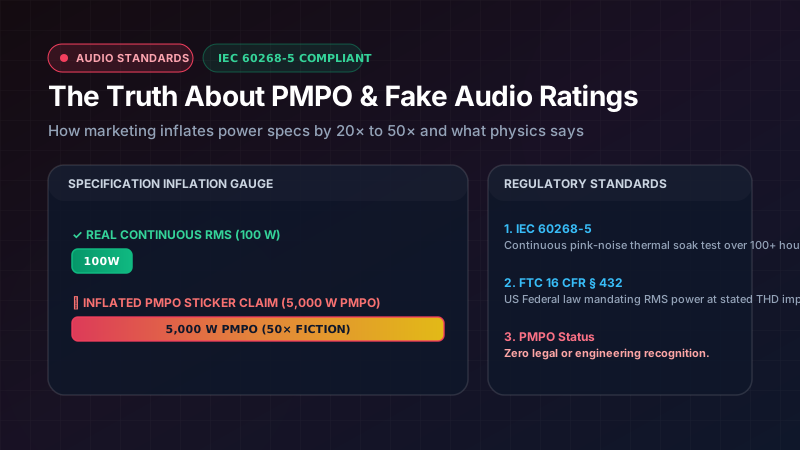
If you have ever browsed e-commerce marketplaces, discount department stores, or budget car audio websites, you have inevitably encountered compact boomboxes, computer soundbars, or party speakers sporting flashy metallic stickers claiming:
“5,000 Watts PMPO Ultra-Bass Output!”
Yet, inspecting the rear panel reveals a tiny external wall power adapter rated at 12 Volts DC, 2.0 Amperes—a total electrical input capacity of just 24 Watts.
How can a device consuming 24 Watts from the wall physically deliver 5,000 Watts of acoustic power to a room?
The answer is simple: It cannot. In this engineering exposé, we dissect the fraudulent mathematics behind PMPO, demonstrate why the First Law of Thermodynamics (Conservation of Energy) exposes fake power claims, analyze the rigorous testing protocols of IEC 60268-5 and FTC 16 CFR Part 432, and provide a reliable de-inflation lookup matrix to calculate true continuous RMS wattage.
1. What Does PMPO Actually Mean?
PMPO ostensibly stands for “Peak Music Power Output” (or colloquially among audio engineers, “Pure Marketing Promotional Output”).
Unlike Continuous Average Power (RMS Power)—which measures the steady-state thermal work an amplifier can perform continuously across the audible spectrum (20 Hz to 20,000 Hz) at a specified distortion threshold—PMPO has zero standardized scientific definition.
┌─────────────────────────────────────────────────────────────┐
│                 THE AUDIO SPECIFICATION GAP                 │
├─────────────────────────────────────────────────────────────┤
│ Advertised PMPO Rating:  5,000 Watts PMPO (Unregulated)     │
│ Peak Sine Wave Rating:     100 Watts Peak  (Physical Limit) │
│ True Continuous RMS:        50 Watts RMS   (IEC 60268-5)    │
│ Wall Power Input:           65 Watts Mains (Conservation)   │
└─────────────────────────────────────────────────────────────┘
PMPO was invented by consumer electronics marketing departments in the 1990s to exploit consumer psychology. Because most consumers equate higher wattage directly with louder sound and deeper bass, manufacturers began fabricating inflated numbers by measuring theoretical burst conditions that can never occur during normal music reproduction.
2. The 5 Ways Manufacturers Falsify Audio Power Specs
Audio engineers have reverse-engineered the measurement tricks unethical manufacturers use to inflate wattage ratings by 10× to 50×:
1. The Microsecond Burst Horizon
Instead of testing an amplifier continuously for hours, PMPO measures the instantaneous burst energy the power supply capacitors can discharge for a few microseconds (e.g., 10 μs). Because real musical bass notes last between 50 ms and 500 ms (thousands of times longer), the power supply collapses instantly during real playback.
2. Theoretical Dead-Short Impedance Loads
True continuous power is measured into standard nominal loudspeaker loads: 4 Ω, 8 Ω, or 2 Ω. Unethical manufacturers calculate PMPO by assuming a hypothetical load of 0.1 Ω or a dead short (0 Ω):
P_fake = V² / 0.1 Ω = 10 × (V² / 1.0 Ω)
In reality, connecting a 0.1 Ω load to the amplifier would instantly melt its output transistors or trigger protective shutdown.
3. Pure Square Wave Clamping (100% THD)
Rather than measuring clean power with Total Harmonic Distortion below 0.1% or 1%, PMPO tests push the amplifier into catastrophic 100% hard square-wave clipping, where the output transistors are shorted directly to the maximum DC power rails.
4. Summing All Channels Into Single Non-Existent Rails
A 5.1-channel home theater system advertised as “1,200W PMPO” often sums the theoretical peak burst of all 6 channels simultaneously, even though the internal transformer can only deliver enough current to power a single channel at a time.
5. Single-Frequency 1 kHz Test Tone
Instead of requiring full-bandwidth reproduction across the entire human hearing range (20 Hz to 20 kHz), manufacturers test exclusively at a single 1 kHz midrange tone where amplifier efficiency is highest, ignoring the heavy low-frequency current demands of bass below 100 Hz.
3. The Physics Reality Check: The Conservation of Energy Test
The easiest and most foolproof method to expose fake PMPO specifications is applying the First Law of Thermodynamics (Conservation of Energy).
An audio amplifier is not an electrical generator; it is an energy converter that transforms electrical energy from the mains wall outlet into audio-frequency AC power sent to the loudspeaker voice coils:
Power Output (P_out) = Electrical Efficiency (η) × Power Input (P_in)
Where η (eta) is the electrical efficiency of the amplifier’s circuit topology:
| Amplifier Class | Typical Electrical Efficiency (η) | Thermal Waste Heat |
|---|---|---|
| Class A | 20% – 30% | 70% – 80% (Heavy heatsinks required) |
| Class AB | 50% – 65% | 35% – 50% (Standard Hi-Fi / Receivers) |
| Class D (Digital) | 80% – 92% | 8% – 20% (Modern compact amps / subwoofers) |
The Conservation of Energy Boundary:
┌─────────────────────────┐     ┌───────────────────────┐     ┌────────────────────────┐
│  Mains Input Power      │ ──> │   Amplifier Circuit   │ ──> │  Max Audio Output      │
│  12V @ 2A = 24W Input   │     │  Class D (85% Eff.)   │     │  20.4W RMS Max Total   │
└─────────────────────────┘     └───────────────────────┘     └────────────────────────┘
                                            │
                                            ▼
                                   Waste Heat (3.6W)
The Universal Sanity Check Formula
To find the absolute maximum theoretical continuous RMS power an amplifier can produce across all channels combined:
P_RMS_Max_Total ≤ V_Input × I_Input × η_Class
Real-World Example:
A “1,000W PMPO” desktop soundbar is powered by an included 19V, 3.42A DC power supply (65W input). Assuming a high-efficiency Class D circuit (η = 88%):
P_RMS_Max = 19 V × 3.42 A × 0.88 = 65.0 W × 0.88 = 57.2 Watts RMS Total
Divided across 2 stereo channels, the real continuous capability is at most 28.6 Watts RMS per channel—not 1,000 Watts!
4. International Engineering Standards That Protect Consumers
Legitimate audio manufacturers, acoustic research laboratories, and regulatory agencies rely on strict international standards to quantify true power:
A. IEC 60268-5 (Sound System Equipment — Loudspeakers)
Established by the International Electrotechnical Commission, IEC 60268-5 specifies exact thermal endurance protocols:
- Rated Noise Power (Continuous RMS): The speaker must withstand a continuous shaped pink noise signal (filtered to match the spectral energy distribution of real music) for 100 continuous hours without permanent alteration of electrical or acoustic characteristics.
- Short-Term Maximum Power: The loudspeaker must survive 1-second bursts repeated 60 times with 1-minute cooling intervals.
B. FTC 16 CFR Part 432 (Amplifier Rule)
Enforced by the U.S. Federal Trade Commission, this rule requires home audio amplifier manufacturers to state:
- Continuous average power per channel in Watts RMS.
- Full rated power bandwidth (e.g., 20 Hz to 20,000 Hz).
- Load impedance (e.g., 8 Ω).
- Maximum Total Harmonic Distortion (THD) threshold (e.g., ≤ 0.05%).
- Prior to testing, the amplifier must undergo a 1-hour thermal pre-conditioning at 1/3 rated power to ensure heatsinks can handle sustained heat.
C. CEA-2006 / CTA-2006 (Car Audio Power Standard)
Administered by the Consumer Technology Association, CEA-2006 eliminates deceptive car audio claims by standardizing test conditions:
- Supply voltage fixed at 14.4 V DC.
- Measured into a 4 Ω load across 20 Hz to 20 kHz.
- Total Harmonic Distortion plus Noise (THD+N) must not exceed 1.0%.
5. Real-World PMPO to True RMS De-Inflation Matrix
Use this empirical conversion table to convert marketing PMPO claims into real continuous RMS power based on laboratory bench testing:
| Advertised PMPO Rating | Equipment Tier | Typical Inflation Multiplier | True Continuous RMS Power (Per Channel) | True System Use Case |
|---|---|---|---|---|
| 300W – 500W PMPO | Budget Bluetooth Speaker / Radio | 30× to 50× | 5W – 10W RMS | Personal desktop listening |
| 1,000W PMPO | Computer 2.1 Soundbar Setup | 20× to 30× | 15W – 25W RMS | Small bedroom / gaming desk |
| 2,500W PMPO | Portable Party Speaker Box | 15× to 25× | 50W – 80W RMS | Backyard BBQ / small party |
| 5,000W PMPO | Consumer “Mini Hi-Fi” Shelf System | 20× to 40× | 60W – 120W RMS | Living room listening |
| 10,000W PMPO | Budget Car Audio “4-Channel Amp” | 25× to 50× | 40W – 75W RMS × 4 | Entry-level car door speakers |
| 20,000W+ PMPO | Cheap No-Name DJ Package | 40× to 100× | 150W – 250W RMS | Small venue PA |
6. How to Measure True Continuous RMS Power on Your Bench
If you want to determine the authentic continuous RMS capability of an amplifier without trusting manufacturer claims, follow this 3-step bench test:
Equipment Needed:
- Non-inductive dummy load resistor (4 Ω or 8 Ω, rated for expected wattage).
- Audio signal generator (or test tone app playing a 1 kHz uncompressed sine wave).
- True-RMS Digital Multimeter (e.g., Fluke 87V) or an Oscilloscope.
Test Procedure:
- Connect the dummy load across the amplifier’s output speaker terminals.
- Inject a 1 kHz sine wave into the amplifier’s line input.
- Slowly increase amplifier volume until an oscilloscope shows the first onset of waveform clipping (or until THD reaches 1.0%).
- Measure the AC voltage across the load resistor using your True-RMS multimeter (V_RMS).
- Compute Continuous RMS Power using the formula:
P_RMS = (V_RMS)² / R_Load
Example: If the multimeter reads 20.0 V RMS across an 8 Ω dummy load, the real continuous power is:
P_RMS = (20.0)² / 8 = 400 / 8 = 50.0 Watts RMS
7. Frequently Asked Questions (FAQ)
Can a 500W PMPO speaker be louder than a 50W RMS speaker?
Not necessarily. Sound Pressure Level (SPL) is determined by two factors: continuous electrical power (Watts RMS) and speaker sensitivity (measured in dB @ 1W/1m). A high-efficiency speaker with 95 dB sensitivity receiving 50W RMS will produce 112 dB SPL, easily outperforming a low-efficiency (82 dB) “500W PMPO” speaker receiving only 10W of real power.
Is PMPO illegal in commercial advertising?
In the United States, the FTC Amplifier Rule (16 CFR Part 432) strictly regulates home audio advertising, making it illegal to advertise peak or PMPO ratings without prominently disclosing the full continuous RMS power specification alongside it. Many other jurisdictions (including the EU and UK under ASA advertising standards) enforce similar consumer protection rules against misleading power claims.
Why do professional PA systems cite “Peak Power” if PMPO is fake?
Professional PA manufacturers (such as JBL Professional, QSC, and Electro-Voice) do not use PMPO. They cite AES Continuous Power, Program Power (2× RMS), and Peak Headroom (4× RMS). These ratings are standardized, mathematically defined, and reflect real dynamic transient capabilities governed by the amplifier’s power supply rail voltage.
Summary & Key Takeaways
- PMPO is a fabricated marketing metric with no standardized testing protocol or physical foundation.
- The Conservation of Energy Law applies: An amplifier can never output more continuous power than its power supply consumes from the wall (
P_out ≤ P_in × η). - True power is defined by international standards: Look for IEC 60268-5, FTC Continuous Average Power, or CEA-2006 certified ratings.
- Typical Inflation: Budget consumer audio inflates PMPO by 20× to 50× over real continuous RMS capability.
Convert your audio equipment specifications accurately using our online engineering tools:
- Main RMS to Watts Calculator — True continuous average power solver.
- PMPO to RMS Calculator — Convert advertised PMPO into realistic continuous wattage.
- RMS to PMPO Calculator — Calculate expected marketing equivalents by market tier.
- Speaker RMS to Watts Calculator — Sizing and load impedance analysis.